
Resistor Color Code Converter
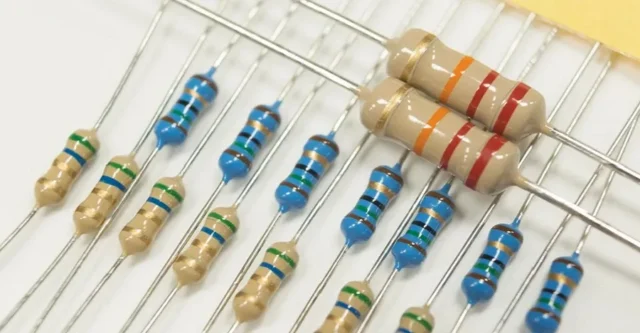
This Resistor Color Code Converter helps you quickly decode resistor color bands into precise resistance values and convert numeric values back into standard 4-band or 5-band color codes. Designed for electronics students, hobbyists, and engineers, the tool supports SI unit formatting and optional E12/E24 series validation. Use it to identify unknown resistors, verify standard values, or prepare accurate component documentation for your circuit projects.
Advanced Resistor Color Code Converter
Color → Value
Value:
Value → Color
Understanding Resistor Color Codes In Modern Electronics
Resistor color codes remain one of the most fundamental identification systems in electronics. Despite the dominance of surface-mount technology (SMT) and digitally labeled components, through-hole resistors with axial color bands are still widely used in prototyping, education, repair work, laboratory setups, and industrial electronics.
The resistor color code system provides a compact, standardized method of encoding resistance values, tolerance, and sometimes temperature coefficient information directly on the component body. This eliminates the need for printed numerical labels, which would be impractical on small cylindrical packages.
A proper understanding of resistor color coding improves circuit debugging accuracy, component verification during assembly, design validation against preferred value series, educational comprehension of resistance scaling, and hardware documentation consistency.
This converter simplifies the process by eliminating manual lookup tables while preserving engineering precision.
Why A Converter Is More Than A Calculator
A resistor tool is often incorrectly described as a calculator. In reality, it performs bidirectional conversion between two representation systems: physical encoding (color bands) and numeric resistance value (Ω with SI prefixes).
A calculator merely computes numeric results. A converter translates between symbolic and numeric systems. In electronics workflows, both directions are equally important:
-
Decoding an unknown resistor during troubleshooting
-
Encoding a specific resistance value for schematic documentation
-
Selecting correct components for PCB assembly
-
Validating stock components against E-series standards
Because of this dual functionality, “Resistor Color Code Converter” is the technically correct terminology.
Structure Of 4-Band And 5-Band Resistors
4-Band Resistors
The standard 4-band resistor contains:
Band 1 – First significant digit
Band 2 – Second significant digit
Band 3 – Multiplier (power of ten)
Band 4 – Tolerance
Example:
Red – Violet – Orange – Gold
Red = 2
Violet = 7
Orange = ×1,000
Gold = ±5%
Result: 27,000 Ω ±5% (27 kΩ)
5-Band Resistors
The 5-band format increases precision:
Band 1 – First digit
Band 2 – Second digit
Band 3 – Third digit
Band 4 – Multiplier
Band 5 – Tolerance
Example:
Brown – Black – Black – Red – Brown
100 × 100 = 10,000 Ω
Tolerance ±1% (if brown tolerance band)
Five-band resistors are typically used in precision circuits, instrumentation, and regulated power supplies.
The Physics Behind Resistance Scaling
Resistance is measured in ohms (Ω), defined by Ohm’s Law:
R = V / I
Where R is resistance, V is voltage, and I is current.
The color code system maps decimal digits to powers of ten. This logarithmic scaling is essential because resistor values span several orders of magnitude:
-
Milliohms (mΩ)
-
Ohms (Ω)
-
Kilohms (kΩ)
-
Megohms (MΩ)
-
Gigohms (GΩ)
The multiplier band encodes exponential scaling, aligning with engineering notation conventions used in circuit design.
E-Series Preferred Values (E12 And E24)
Resistors are not manufactured in every possible numeric value. Instead, standardized logarithmic value sets ensure production efficiency and predictable design behavior.
E12 Series
12 values per decade:
10, 12, 15, 18, 22, 27, 33, 39, 47, 56, 68, 82
Common in general consumer electronics, hobbyist kits, and educational labs.
E24 Series
24 values per decade, including intermediate values such as 11, 13, 16, 20, 24, 30, 36, 43, 51, 62, 75, 91.
Used in precision analog circuits, industrial electronics, and measurement systems.
The converter’s validation feature checks whether the selected resistance matches standard manufacturing series, reducing design inconsistencies.
Tolerance And Real-World Implications
Tolerance defines how much the actual resistance may deviate from its nominal value.
Common tolerance bands include:
Gold – ±5%
Silver – ±10%
Brown – ±1%
Red – ±2%
For example, a 10 kΩ ±5% resistor may measure between 9.5 kΩ and 10.5 kΩ.
Tolerance is critical in voltage dividers, timing circuits (RC networks), sensor signal conditioning, and analog amplification stages. Ignoring tolerance can introduce cumulative design errors.
Practical Use Cases For The Converter
Electronics Troubleshooting
When diagnosing a malfunctioning PCB, color bands may be partially faded or ambiguous. The converter accelerates identification without relying on printed charts.
Educational Environments
Students often struggle with memorizing the color-digit mapping sequence. Interactive conversion reinforces learning through immediate feedback.
Hardware Design Workflow
During schematic drafting, engineers must select realistic component values. Encoding numeric values back into valid color bands ensures documentation accuracy.
Inventory Verification
Component kits frequently contain mixed values. This tool helps confirm resistor markings against packaging and BOM documentation.
Comparison With SMD Code Markings
Surface-mount resistors typically use numeric codes such as 103, meaning 10 × 10³ = 10 kΩ. While different from color codes, both systems rely on exponential representation principles.
Understanding axial color coding improves comprehension of SMT labeling conventions and scaling logic.
SI Unit Formatting And Engineering Notation
Engineering notation improves readability and reduces error probability:
4,700 Ω → 4.7 kΩ
2,200,000 Ω → 2.2 MΩ
Proper SI prefixes prevent interpretation errors, improve technical documentation clarity, and align with IEEE and IEC conventions.
The converter automatically formats results to professional engineering standards.
Common Mistakes In Manual Decoding
Typical decoding errors include:
-
Confusing brown and red under poor lighting
-
Misidentifying the tolerance band position
-
Reading from the wrong end of the resistor
-
Forgetting multiplier scaling
-
Ignoring preferred value constraints
Digital conversion eliminates these risks and increases reliability.
Why Resistor Identification Still Matters
Despite advanced CAD software and automated BOM systems, real-world electronics still involves legacy system repair, field maintenance, rapid prototyping, educational training, and laboratory experimentation.
Through-hole resistors remain common in audio circuits, power electronics, sensor modules, amateur radio equipment, and DIY microcontroller projects.
Understanding color coding remains a core electronics competency and a foundational engineering skill.
Engineering Best Practices
When working with resistor values:
-
Verify tolerance for precision circuits
-
Confirm E-series compatibility before procurement
-
Use engineering notation in documentation
-
Double-check multiplier scaling in high-resistance ranges
-
Store resistors organized by decade values
The resistor color code system is a compact, logarithmic encoding method developed for reliability and scalability. While simple in appearance, it reflects fundamental electrical engineering principles involving exponential scaling, tolerance modeling, and standardized manufacturing.
This converter bridges traditional physical encoding with modern digital workflows, streamlining resistor identification while maintaining technical accuracy.
The images in this article were created using artificial intelligence or sourced from lawful, freely usable providers — such as Pixabay or Pexels.


